Pages

Showing posts with label bowel. Show all posts

Friday, 23 November 2018

Bowel Surgery for Endometriosis


Hello again readers, 2018 is rapidly drawing to a close and I’m making an early new year’s resolution to update this blog more often, it is called ‘endometriosis update’ after all and I feel I haven’t been doing enough updating.

I recently had the pleasure of being invited to the Endometriosis Research Now! Conference in London organised by Endo UK, the World Endometriosis Research Foundation and supported by the Wellcome Trust. I gave a talk on the way in which scientific evidence about endometriosis is portrayed and how we can critique this evidence (pretty much everything I covered in this post from earlier in the year). It was a great day meeting other endo specialists and hearing the voices of women with endo to learn more about what I can do to further awareness. More on that to come in a later blogpost though when all the promotional material has been sorted by Endo UK.

For the subject of this post I’m going to talk about a recent study analysing the results of bowel surgery in women with endometriosis. You can read the full text of the source article here for more detailed information about the study.

Some forms of endometriosis can penetrate deep into the pelvic organs, one site in which this can occur is the tissue that divides the vagina and the rectum, called the rectovaginal septum (you can see some common sites of rectovaginal endo here, and learn more in the yellow fact box below). This form of endo can present a particular set of challenges when it comes to management and treatment of the disease. Evidence is mixed concerning the effectiveness of medical therapy for rectovaginal endometriosis, so surgery is often recommended as the preferred treatment choice. But what are the outcomes of this surgery, and how effective is it at managing symptoms of the disease?

A recent study published in the British Medical Journal examined data from 4,721 women undergoing planned surgery for deep rectovaginal endometriosis between 1st January 2009 and 30th June 2016 in centres belonging to the British Society for Gynaecological Endoscopy ‘Endocentres’ (specialist endometriosis treatment centres where patients are treated in multidisciplinary teams and surgeons audit their outcomes. For a list of such centres, see this link).

The authors of this study recorded a lot of information on these patients, in particular their pain levels, symptoms, bowel functioning, drug treatments, surgery complications, and quality of life surveys called the EQ-5D-3L (EQ5D) and the EuroQoL Visual Analogue Scale (EQVAS). All this data was recorded before surgery and at 6 months, 12 months and 24 months after surgery to see how/if any of those recorded factors had changed.

Let’s get right into the findings, starting with pain symptoms. For this study they asked the patients to rank their pain on a scale of 0-10, with 0 being no pain at all, and 10 being the worst possible pain.
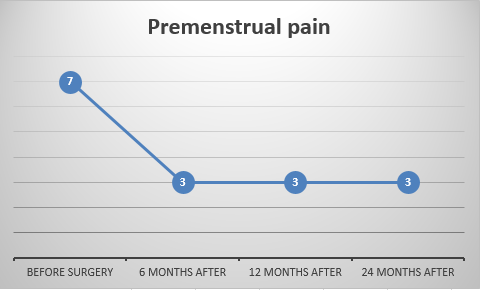
Below are some graphs showing the average before and after surgery pain scores for different symptoms in the patients who participated in this study


It’s good to see that, on average, the pain scores decreased for all types of pain symptoms after 24 months post-surgery. In particular, cyclical and non-cyclical dyschezia (painful bowel movements) were lowered, although cyclical dyschezia did seem to increase slightly again after 2 years. Whether this represents a return of the disease or not requires further study.

So, pain symptoms are reduced after rectovaginal surgery, does this translate to improved quality of life? The graphs below show scores representing results of the two different quality of life surveys (the EQ5D and the EQVAS). The higher the number of each score, the better the average quality of life.


In both cases these scores increased and remained higher after surgery. This means factors like levels depression and anxiety got better, mobility increased and ability to do daily activities increased too. 

Another way to assess whether or not the results of the surgery was successful, is to look at the use of medication before and after the surgery. The graphs below show the different types of medication the women in this study were using (i.e. paracetamol, NSAID – non-steroidal anti-inflammatory drugs like ibuprofen, or opiates like codeine) and the average percentage of people using that medication type before and after their surgery.


Overall the use of any type of pain medication, on average, fell sharply at the 6 months after surgery point, but crept back up slightly at the final 2 year point. This is consistent with some of the other graphs showing slight pain recurrence at the same 2 year point. While the use of pain medications is reduced after surgery, for paracetamol and NSAIDs their use still hovers in the 50-60% range, meaning more than half of women still needed to take pain medication. Whether the continuing need for pain medication is just due to rectovaginal endometriosis related symptoms, or to other types of endo, or other conditions all together, needs further clarification.

One of the tricky parts of rectovaginal surgery is that it can deal with operating on a particularly challenging organ – the bowel. Your bowels are in pretty heavy use all the time and work hard to move digested food where it needs to go. So operating on this sensitive part of the body can, rarely, result in complications arising during, and after surgery. Below is a diagram showing the percentage of perioperative complications, that is, complications arising during surgeries in this study.


 As you can see, the vast majority of surgeries went without complications. Of the few complications that did arise, the majority were unexpected injuries, or the need to covert the laparoscopic surgery to laparotomy. Both of these are manageable by a multidisciplinary team such as the ones used in this study and, although it means further monitoring of patients after the surgery is complete, it wouldn’t necessarily mean the patient didn’t get a good outcome.

Those are the complications that arose during surgery, what about complications that came about after surgery? The diagram below shows the percentage of post-operative complications.


 Again we can see that most women didn’t have any complications after surgery. Of those that did, the most reported type of complications were pelvic haematoma (when blood collects outside the blood vessels), pelvic abscess (as the result of infection), bowel leak (bowel incontinence), and bowel fistula (a hole that forms between one organ to another). All of these complications are manageable as long as patients stay aware of any unusual symptoms after surgery and report them to their doctor as soon as possible.

Of course, not all types of surgery are the same, depending on the type and extent of endometriosis, some will require more complex or extensive removal, and so, have the potential to lead to more complications. The graph below shows the percentage of complications arising depending on whether the surgery involved any bowel surgery at all, bowel shaving (where a thin slice of the bowel surface is removed and any endometriosis excised), disc resection (where a small section of the bowel is cut out), or segmental resection (where a larger portion of the bowel, plus a small part either side of the affected area, is removed and the remaining parts joined back together).  


From these results we can see that, although complications were overall infrequent, disc resection and segmental resection had the higher complication rate. This is perhaps unsurprising given that these techniques do involving cutting into and removing part of the bowel, but it is also a testament to how advanced surgery techniques and skills have become that so few complications do occur.

What are the overall conclusions of this study? You can draw your own from the results I’ve shown here, but I think the main take home message is that complex surgery for the removal of endometriosis, especially when it involves the bowel, requires a multidisciplinary team of experienced surgeons. When it is done right, rectovaginal surgery for the removal of deep endometriosis decreases pain scores and symptoms, and improves quality of life over at least a two year period, so women with endometriosis need to have access to these specialist treatment options to effectively manage their condition.


Wednesday, 3 July 2013

June Roundup in July


Unfortunately I’ve been a bit behind this month, but I always keep my eye on what going on in the world of endo research.

So with that in mind let’s have a look at what’s been going on

Firstly, a study into surgical treatment for endometriosis of the bladder. This form of the disease isn’t particularly common, but it does add another layer of misery to the sufferer so knowing the optimal treatment is important. This study took sixty nine patients with bladder endometriosis and recorded what surgical procedures they had and how this affected their symptoms afterward. After follow up period of between 4 and 92 months, 92.7% of the women either had no symptoms, or a reduction in symptoms. What this study highlighted was the need for surgeons with specialist training in different types of endo (i.e. bladder, bowel etc) as they may require a different surgical approach.

Speaking of bladder and bowel surgery, up next is a report on the use of robotic assisted surgery for the treatment of just those conditions. This study included 19 cases of bowel surgery and 5 cases of bladder surgery, all of which occurred without complications. Now, robot-assisted surgery is a hot topic at the moment because it is a new and growing technique. But we are also stuck in a catch-22 situation with robotic surgery. You see, people are reluctant to support robotic surgery until there are more studies into its effectiveness, but you can’t have more studies until you support wider use of robotic surgery. Either way it looks like robotic surgery is here to stay and it is a safe and effective tool with a skilled surgeon at the helm.

Speaking of robot-assisted surgery, there are many different types of surgical procedure the robot can be utilised for in the treatment of endometriosis. In severe cases of the disease, doctors may opt for hysterectomy and our next study examines the safety and effectiveness of using the robot for such a procedure. In summary this study looked at 43 cases of women with severe endo (19 with stage III and 24 with stage IV). The results of which were -  operating times averaged at 145 minutes (with a variation of 67-325 mins); 41 out of 43 women only had a 1day hospital stay, with one woman needing to stay for 5days due to needing a laparotomy and one woman staying 3days because of a bowel obstruction that cleared. There were no reported complications during surgery though after surgery one woman had to be readmitted with a vaginal cuff abscess which was treated with antibiotics and drained. The authors of this study make some good points about the pros and cons of robotic surgery, namely – “The robotic platform improves the depth of perception and facilitates the resection of deep infiltrating lesions. In addition, the robotic system improves dexterity, filters the surgeon’s tremor, and improves intuitive movements”; however they also say “Robotic surgery has several disadvantages compared with traditional laparotomy. These include increased cost; the lack of tactile feedback to the surgeon [i.e the ‘feel’ of the toughness or resistance of tissues]; the presence of bulky robotic arms, as well as long and thick cords; the inability to move the surgical table once the robot arms are attached; and a limited range of motion with respect to operating in different quadrants in the same case”.

Sticking with a surgical theme is a study from the US looking at the effectiveness of surgical excision of endometriosis across five different medical centre’s. All the women included in this study were suffering endometriosis associated pain, of which 90 had operative information. Once these women were operated on, 65 were confirmed to have endometriosis and 25 had no confirmation of endo. Interestingly, of all the patients who had endometriosis confirmed at these centres, 84.6% had previously been given hormonal therapy or ablation (burning away of endo) surgery, indicating that these treatments are not very effective at reducing endo pain symptoms.  After their surgeries, all of the women in the different centres noticed a significant reduction in all but bowel symptoms (bowel symptoms were reduced though, but the amount of reduction wasn’t considered statistically significant). Interestingly the authors of this study found there was no significant difference in the pain and quality of life scores between women who were given hormonal therapy after excision surgery and those who weren’t. However, the post-operative information was collected 6 months after surgery, so long term effectiveness couldn’t be gauged. In any case this study shows that excision of endometriosis is still the preferred method of treatment for the disease where possible.

It is rapidly becoming apparent that endometriosis is a disease that begins to present itself in adolescence. This is extremely important to know because it means general practitioners need to be able to spot the signs of endometriosis in young girls and make sure they get treatment as soon as possible. But what are the major signs of endo? A new study looking at diagnosis of endo in adolescent girls found that 75% of girls with chronic pelvic pain (which is any pain in the pelvic area that lasts more than six months) that did not respond to medical treatment and 70% of girls with dysmenorrhoea (excessively painful/heavy periods) were later diagnosed with endometriosis. All doctors need to be aware of these ‘red flags’ and act on them quickly.

Next up is copper, which is great for electrical wiring and making cheap jewellery, but also may be important for endometriosis. Our bodies need miniscule amount of copper to function properly, but as with so very many things in this world, there is fine balance to be kept. In your body copper can float around by itself, but is also carried around by a protein called ceruplasmin and this latest study looked at the levels of both of these in the blood of women with advanced stage endometriosis compared to disease free women. What they found was that levels of copper and ceruplasmin were much higher in the blood of women with endo, but what does this mean? That’s a tricky question to answer because we’re still not sure what role copper might play in endo. Excess levels of copper are known to be a marker for oxidative stress and oxidative stress certainly seems to be elevated in women with endo. Oxidative stress, as the name suggests, is not something you want happening to excess in your body; prolonged exposure to oxidative stress can make you run down and generally feel like crap, in addition localised oxidative stress can actually promote the survival of endometriosis. Further study is needed to find out if copper is a cause or effect of oxidative stress, but as an interesting aside, elevated levels of copper in the blood could possibly be used as an indicator of advanced stage endometriosis.

Finally is a study from Denmark about the risk of endometriosis and fertility problems in the daughters of women with the disease. This was quite a large study, including information from 12,389 women with endometriosis and 52,371 without. Overall daughters of women with endometriosis were just over two times more likely to be diagnosed with endo. However, daughters of women with endo had no difference in the rate of deliveries, risk of miscarriage and ectopic pregnancy compared to the daughters of women without endo.  

Monday, 18 March 2013

Endometriosis Awareness Month 2013 – Part IV


Rapidly continuing our voyage into endometriosis research over recent times we find ourselves in familiar territory. I’ve always had an inkling that endometriosis is a condition women are born with, but without a body of evidence to support it, it would remain just an hunch. However, over the years I’ve been writing this blog there has been a noticeable growth in evidence supporting the notion that the decision as to whether a woman will, or will not development endometriosis, is made before she is born.

Recently another paper has been published from the research group that identified displaced endometrial tissue, characteristic of endometriosis, in human foetuses. Although this time the researchers were looking at genetic differences between normal endometrial tissue and endometriotic tissue. What they found was that two genes of particular interest were altered in the endometriotic tissue, namely BMP4 and GREM1. What makes these genes so interesting is that both appear to be involved in Müllerian duct differentiation. I’ve talked before about the Müllerian duct and how it is basically the precursor to the female reproductive system during foetal development. The process of differentiation is when cells become specialised to carry out a certain function within the body.  We all started off as a single cell, but in order to become the complex organisms we are, as our cells divided they had to acquire specialisations. So during the development of a female foetus, the Müllerian duct begins to differentiate into the specialised tissue types (such as endometrium, myometrium etc) it eventually becomes in an adult. What this piece of research highlights is that it appears as if, by some as yet unknown mechanism, endometriotic tissue arises because of an error in cellular differentiation during the formation of the female reproductive system long before you are even born.

Continuing along a similar line is the next paper which examines what happened to mice whose mothers have been exposed to hormonal manipulation whilst they were pregnant. This study took pregnant mice and exposed them to a compound called ethinyl estradiol during days 11 to 17 of their pregnancy. Ethinyl estradiol (EE) is a synthetic version of the human form of estrogen; it’s most often used in hormone replacement therapy (HRT) or in combination with a progestin in contraceptive pills. After the mice were born they were kept up to the age of 28 weeks old then killed and their reproductive organs examined. What the investigators found was that mice exposed to EE prenatally developed a far greater number of endometriosis like lesions on their ovaries and adenomyosis was also found to be far more obvious in the uteri of exposed animals.
It’s interesting to note that the authors didn’t record any endometriotic lesions in any other locations apart from the ovaries in these exposed mice. In last week’s post I mentioned a piece of research that subtlety hinted ovarian and peritoneal endometriosis may have different origins and this study also hints at the same possibility (Although, if you want more than just hints, there have been whole reviews dedicated to the difference between the different types of endometriosis, by authors far more knowledgeable than myself).

Of course when considering this latest study we must take several things into consideration. Most importantly that this was a study using mice and although mice make good models for investigating human disease they can never be considered perfect, especially when looking at reproductive conditions. If we look at the difference between the female reproductive system in the mouse and human, not only do they look different, but they function differently as well. Mice, for example, have oestrus cycles (i.e. they can only get pregnant when they are ‘in season’) but humans have menstrual cycles which differ in many ways. Therefore, although this research does certainly gives us pause for thought, we can’t make a leap of suggesting the same hormones will have the same effect in different animals.

Pictured above - not a human (Image courtesy of morgueFile)

 Finally for this week is a study into digestive function after surgery for endometriosis involving the rectum. This study followed 75 women undergoing surgery for deep endometriosis infiltrating the rectum; 24 of whom underwent surgery when more radical methods were in favour, and 51 who underwent surgery when conservative methods were more in vogue. Afterwards each patient was given a number of different questionnaires to assess the health and function of their bowels as well as assessing their overall health, both physical and mental.
This study found that 67% of women undergoing surgery during the radical phase had a colorectal resection (where part of the bowel is removed), compared to only 20% of women who underwent surgery during the conservative phase. Women who underwent the more conservative surgery mostly had either localised excision of the disease or a procedure delightfully known as rectal shaving (Googling that term gives a number of very interesting, but unrelated results, so I’ll spare you the blushes and just link to a relevant video of rectal shaving of endometriosis actually being performed).
After the results of the various questionnaires had been analysed it was found that women who underwent the conservative surgeries fared much better in terms of digestive function and bowel movements than those who underwent radical surgery. Overall this study shows that the ‘sledgehammer to crack a walnut’ approach to removing colorectal endometriosis is not always in the best interests of the patient and more extensive training in conservative techniques is needed for surgeons treating women with endometriosis.


Wednesday, 17 February 2010

Full of Hot Air

As you probably all know endometriosis has a list of symptoms as long as my arm (and I have long arms), which is one of the major barriers to speedy diagnosis. Some of the symptoms are more common (or more well recognised) than others. For example, painful, heavy periods and pain during intercourse are two of the most widely reported. In my experience some of the least well recognised symptoms of endometriosis are painful bowel movements (often dismissed as Irritable Bowel Syndrome) and chronic fatigue (often just dismissed).

However, a recent study has highlighted one of the least well recognised symptoms, abdominal bloating. Chances are, if you have endometriosis or not, you have experienced abdominal bloating but might have thought it was just caused by something you ate. This study took 26 women with endometriosis and 25 women without and got them to fill out questionnaires as well as measuring the girth of their abdomen throughout the menstrual cycle. According to this study having endometriosis meant that you were much more likely to experience abdominal bloating, 96% of women with endo reported abdominal bloating compared to 64% of controls, and your abdominal bloating was likely to be much more severe and can be accompanied by hand swelling and cycles of diarrhoea and constipation.

That study came just a few months after one I wrote about in September, which also concluded that bloating was the most common gastrointestinal symptom of endometriosis. However, it transpired that gastrointestinal symptoms were not related to involvement of endometriosis with the bowel which raises more questions than it answers. How can it be that women with endometriosis present with so many gastrointestinal symptoms, but endometriosis isn’t necessarily present on the bowel? One answer I can think of is that the female reproductive organs and the bowel exist in very close proximity to one another. Inflammatory factors produced by diseased tissue on the ovaries or uterus could therefore come into contact with the bowel causing inflammation of the bowel, resulting in the multitude of unpleasant symptoms many women associate with endometriosis. That’s my guess anyway, if you happen to know for sure, don’t keep it to yourself!

Tuesday, 8 September 2009

Mysterious bowels

Endometriosis is well known, especially by the sufferer, to cause a myriad of symptoms. Apart from the obvious pelvic pain, gastrointestinal symptoms appear to be the next most common. This can often lead a patient with endometriosis to think that maybe the disease is present on the bowel.

A new study has been published recently that may allay some of those fears though. A paper published in the Australian & New Zealand Journal of Obstetrics and Gynaecology. This study found 290 women with endometriosis of which 90% had gastrointestinal symptoms. The most common symptom was bloating. Of the 290 women, only 7.6% actually endometriosis on the bowel which is a surprisingly small number. Of course this raises the problem of why, if there is no endometriosis on the bowel, do patients experience bowel problems? I don’t have the answer myself and I can only theorise upon what it might be. It could be that adhesions, a separate entity to endometriosis, are present on the bowel which may cause problems. It could be that problems with the immune system that are often present in women with endometriosis, play a role in altering the function of the bowel. It still remains a bit of a mystery.

Oh and it will probably come as no surprise to any of you that 76 of the aforementioned women were originally misdiagnosed with irritable bowel syndrome.