Pages

Showing posts with label infection. Show all posts

Friday, 20 March 2015

Endometriosis Awareness Month - Part III


Endometriosis is a puzzling disease, there are still many unanswered question surrounding its origin, who gets it and why. In this way it makes studying endometriosis like exploring the world in the 17th century, there is a sense of undiscovered territory to explore, but rather than large wooden ships and subjugating natives, we have theories and hypotheses to test with science. Some of those theories prove worth exploring, some have a little, a lot, or no evidence to support them. Creating new theories sometimes seems like muddying the water and complicated an already complicated subject, but it is only by coming up with and testing new ideas, we get closer to the truth (however, all ideas must be testable and all tests must be fair, objective and subject to scrutiny by peer review, something pseudoscience always fails at).

With that in mind I’m going to be doing a bit of theorising myself in this week’s blog post. A big part of my research is examining the role that inflammation plays in endometriosis, specifically what controls inflammation in endometriotic and normal endometrial tissue. Part of this research involves looking into the initial causes of inflammation, and one thing in particular has caught my attention recently and that is bacteria.

Some types of bacteria are essential for our health, without them we would become very ill indeed and several of our organs have their own population of micro-organisms that help them function correctly. The gut and the vagina are two good examples, the gut in particular contains between 500 and 1000 different species of bacteria, numbering in the trillions of individual micro-organisms. Interestingly, the harmless bacteria that naturally populate the vagina actually help prevent infections by more harmful bacterial types. But sometimes disruption of the natural order of our internal microflora can lead to harmful effects.

Now I’m not falling into the trap of confusing endometriosis with endometritis and I’m certainly not suggesting that endometriosis is an infection or caused by an infection. Rather bacteria may play a hitherto under-recognised role in inflammation and the generation of painful symptoms in endometriosis.

How might bacteria contribute to endometriosis? To clarify I’m talking about a specific type of bacteria, called Gram-negative bacteria, which is a group of bacteria including E.coli, one of the better known species of bacteria. Why these organisms are important is because of something they secrete, namely lipopolysaccharides (LPS). LPS are essentially toxins the bacteria produce that are responsible for making you ill, but they are also powerful stimulants for inflammation and this is the key point of interest.

To start with we need to know which bacteria are normally present in the uterus and how this differs in women with endometriosis. A study published in 2014 investigated this very phenomena and found that several bacteria types, especially E.coli, were increased in the endometrium of women with endometriosis (see the figure below)


The solid white boxes represent the levels of micro-organisms found in the endometrium of women without endo, the dashed boxes represent the levels in women with endo.Figure source: http://humrep.oxfordjournals.org/content/29/11/2446.long

The solid white boxes represent the levels of micro-organisms found in the endometrium of women without endo, the dashed boxes represent the levels in women with endo.

What we can see from this is that there are several types of micro-organism found at increased levels in the endometrium of women with endometriosis, in particular a large increase in E.coli. Following on from this further studies found that LPS was found at a much higher concentration in the menstrual fluid and peritoneal fluid of women with endo as you can see if you click this link and look at figures C and D (the white bars represent the levels of LPS in women without endo, the black bars are women with endo). 

The increase in LPS in the menstrual fluid can be attributed to the increase in E.coli in the endometrium, but what about the peritoneal fluid? This can be explained by retrograde menstruation, where menstrual fluid is passed upwards through the fallopian tubes and out into the peritoneal cavity. Retrograde menstruation is a natural event in the female body during menstruation, occurring in as much as 90% of women and it was long thought that this was the root cause of endo, with endometrial cells shed during a period being passed into the peritoneal cavity where they implant and grow. This theory has since fell from favour somewhat as more evidence accumulates against it being the cause of endo, but there may be a role for retrograde menstruation in endometriosis, just perhaps not what was previously thought.

It seems plausible then that increased levels of E.coli in the endometrium lead to higher concentrations of LPS in the menstrual blood, which can get refluxed into the peritoneal cavity by retrograde menstruation, increasing the concentration of LPS in the peritoneal fluid, which can be in close/direct contact with endometriotic lesions. The next step is to assess what can happen when
LPS interacts with endometriosis.

Some studies have looked into this and found that LPS can stimulate endometriotic cells to release factors, like prostaglandin E2 (PGE2) and tumour necrosis factor (TNFα)  which promote inflammation and stimulate pain signals (PGE2 has been implicated in a number of important facets for endometriosis survival including cell growth, inhibition cell destruction and hormone production). This would lead to a heightened inflammatory state around endometriotic lesions and in the normal endometrium, possibly contributing to symptoms frequently associated with endometriosis, such as chronic pelvic pain and excessively painful periods. The whole process can be summed up on the diagram below.
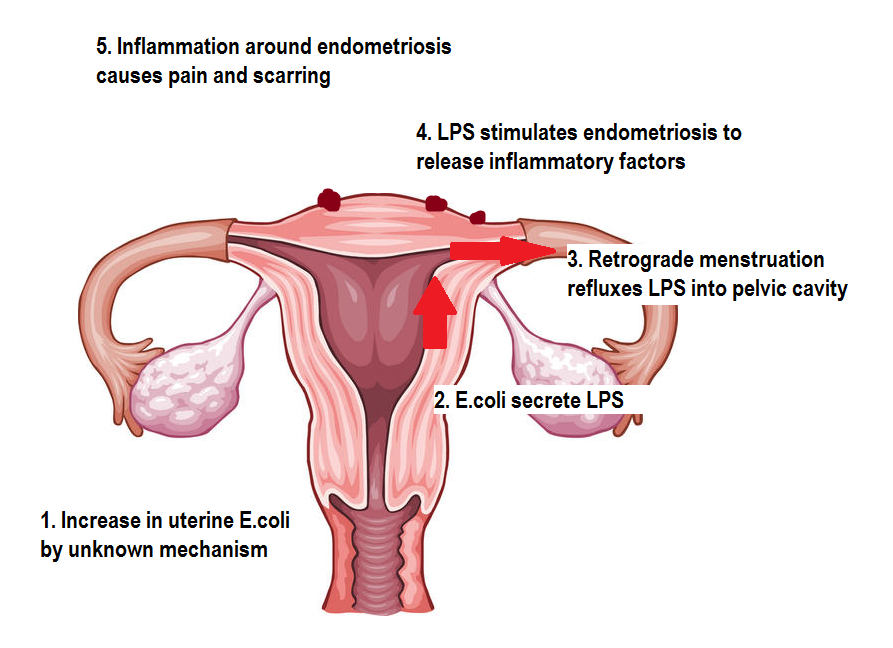

Original image from https://edc2.healthtap.com/ht-staging/user_answer/reference_image/7081/large/Uterus.jpeg?1386669522

The final question, which we don’t have an answer to yet, is why E.coli and other micro-organisms are increased in the endometrium of women with endo.  It may be due to alterations of vaginal acidity leading to easier colonisation of the uterus by bacteria, or dysfunction of the immune cells in the uterus of women with endo resulting in them not being able to keep micro-organisms in check? Also, what effect would restoring the normal balance of uterine micro-organisms have and how can this be achieved? There are a lot of issues that need to be addressed here, but hopefully this will be an area of investigation that yields positive results in terms of relief from painful symptoms.

Friday, 7 March 2014

Endometriosis Awareness Month - Part 2


Endometriosis is a disease of many facets, pain being the most obvious and prevalent one. However there are other aspects of the disease that have a significant impact on the sufferer that receive less attention. One such aspect is infections.

Despite studies showing that women with endometriosis are more commonly affected by respiratory tract infections and recurrent vaginal infections, there is relatively little investigation into the reason behind this observation.  Some point to alterations in the immune system of women with endo that may reduce the body’s defence against to infection. Other studies found the menstrual blood of women with endo has higher levels of factors which promote the growth of certain bacteria.

Whatever the cause may be, it is still an area if ongoing interest and there have been two studies published very recently investigating different types of infection in women with endo.

The first study, from Japan, was designed to see if there is any association between endometriosis and endometritis. Endometritis is often confused for endometriosis, if only for the similarity of the words, but they are in fact very different conditions. Endometritis is an inflammation of endometrium, which can be due to infection by a number of different bacteria and, although generally may not present with any symptoms, it can cause lower abdominal pain, vaginal discharge and fever. 

This study took 34 women with endometriosis and 37 without endometriosis, who were undergoing hysterectomy, and analysed their endometrium for signs of endometritis. Most of the characteristics of the women (such as age/BMI/menstrual cycle length) didn’t significantly vary. However, adenomysosis was found in 47% of the women with endo, but only 8% of the women without endo. In addition, fibroids were found in 68% of the women with endo and 95% of the women without (but we must remember these were women scheduled for hysterectomy, so it would be expected to see high percentages of uterine conditions).

After analysing the endometrium the investigators found there was a significant association between having endometriosis and chronic endometritis. 53% of the women with endo were also diagnosed with endometritis, but only 27% of the women without endo had endometritis.

Breaking endometriosis cases down by stage also yielded some interesting results, below is what the investigators found

Endometriosis Stage
Percentage of women with endometritis
Stage I
40%
Stage II
50%
Stage III
70%
Stage IV
47%

The increase in endometritis as stage increases (up to stage III) is an interesting find, but the number of women used for this part of the analysis was very small, which might make the results seem more significant than they would be if you repeated this study with a larger number of patients. It would have been interesting to see if endometritis was associated with any specific symptoms of endometriosis (such as dysmenorrhea, chronic pelvic pain, subfertility etc) as stage of disease is not really related to severity of symptoms.

When discussing their findings, the investigators suggested that endometritis in women with endometriosis may not necessarily be due to infection. Endometritis was defined, in this instance, by the presence of plasma cells (a type of white blood cell) in the endometrium not the direct observation of bacteria. The endometrium of women with endometriosis has a number of alterations; so there may be some factor produced by the endometrium of women with endo that causes these plasma cells to appear. It could even be that the cause of endometritis in women with endo lies outside the uterus. The pelvic environment is linked to the uterus via the fallopian tubes, therefore it is possible that some inflammatory factor produced by endometriosis might travel into the uterus and cause the changes that were observed in this study. As is usually the case with a new discovery, it raises more questions than it answers, but this certainly opens the door to new areas of research.

Onto the next study then, from Israel, which investigated pelvic inflammatory disease (PID) in women with endometriosis. PID is one of the common misdiagnoses of women with endo as the symptoms (such as pelvic pain, painful sex, heavy, painful periods) are quite similar to those of endo, though PID may not have any obvious symptoms. PID is caused by a bacterial infection in the vagina or cervix, which then spreads up into the uterus or fallopian tubes, it can be diagnosed with a cervical swab and is usually successfully treated with a course of antibiotics.

The investigators reviewed medical records of women admitted to their hospital, between 2008 and 2011, for either PID or tubo-ovarian abscess (TOA, basically an abscess of the fallopian tube or ovary) and divided them into two groups. Group 1 was 21 women who also had stage III-IV endometriosis and group 2 was 127 women without endometriosis.

Unsurprisingly when the records were reviewed the investigators found that women in group 1 had much more fertility treatments or IVF than those in group 2. What was surprising was the way PID or TOA affected women with endo. In this study, women with endo experienced significantly more severe PID infections which required a longer hospital stay, a higher rate of failure to respond to antibiotics and, in some cases, surgical intervention.

The authors point out that PID and TOA seemed to be more likely to develop in women with endo after undergoing fertility treatments, in particular IVF. This may have something to do with the association of ovarian endometriotic cysts (endometrioma) with TOA. The authors suggest that the blood and fluid that builds up inside an endometrioma might serve as a kind of ‘growth serum’ for bacteria and if a cyst is ruptured (either naturally or is pierced during surgery or oocyte retrieval) it could potentially spread infection through the reproductive organs.

It would be interesting to repeat this study with more women of stage I-II endometriosis to see if the association holds, or whether severe PID infections are only more common in women with stage III-IV disease who have recently undergone fertility treatment. Obviously it would be beneficial to follow this up with studies into how to prevent severe PID in women with endometriosis or how to better treat it. The authors found that 76% of the women with endometriosis had already undergone at least one surgery which didn’t seem to decrease their risk of developing PID. Perhaps modifying surgical approaches to include cleaning of the pelvic area or treating women with ruptured endometrioma with antibiotics after surgery as a precaution may help? Again there is still much work to be done before we have some answers and better clinical care for women with endo can be achieved, but now the problem has been highlighted, we can work towards a solution.

As an aside, a fellow endo blogger and activist from Brazil who writes the Endometriose e Eu blog is currently in the running to win award for her writing. It would be awesome if anyone reading this could vote for her blog to help put endo in the spotlight in Brazil. Simply go to this page and in the top right you should see boxes to vote by email and Facebook, obrigado!